10.26.2009

2009 October herping trip

My coworker and friend Brandon and I recently drove to Blacksburg, VA for our annual "Big Meeting" of Jeff Walters' various employees, grad students, and post-docs. As I've done in past years, I augmented the trip to and from Blacksburg and did some herping/hiking and visited family. I'll cover some of the highlights in the brief (ha ha) series of photos below.

These next four photos are of my favorite salamander of the trip.


Green Salamander (Aneides aeneus)


Green Salamander in damp rock crevice where it spends much of it's time.


Pigeon Mountain Salamander (Plethodon petraeus) in deep crevice, similar to Green Salamander behavior


Pigeon Mountain Salamander out on the prowl


Northern Slimy Salamander (Plethodon glutinosus)


This Allegheny Woodrat (Neotoma magister) was an amusing addition to our experience. It was constantly scampering past us, to and fro, as it gathered acorns to store for the winter. You can only see it's little snout with an acorn sticking out from under the log.


I wasn't expecting to find scorpions under logs at high elevations in Northern Georgia, so this made a good consolation prize in the absence of the salamanders I was hoping to find at this location. If anyone knows what scorpion species occurs in Chattooga County, GA, I'd be interested to know.


Adult Northern Red Salamander (Pseudotriton ruber ruber)


Showy Gentian (Gentiana decora)


Blue Ridge Two-lined Salamander (Eurycea wilderae)


Southern Appalachian Salamander? (Plethodon teyahalee)


Peaks of Otter Salamander (Plethodon hubrichti)


Dixie Caverns variant of Wehrle's Salamander (Plethodon wehrlei)


I'll only say we were driving in the correct lane...


I appreciated the similar growth forms of this Lycopodiella and Selaginella.


A curious White-footed Mouse (Peromyscus leucopus)


Valley and Ridge Salamander (Plethodon hoffmani)


Many-lined Salamander (Stereochilus marginatus)


Flash photo of Many-lined Salamander to show the thin lateral streaks for which this animal is named


Southern Dusky Salamander (Desmognathus auriculatus) This species has experienced one of the steepest declines of any amphibian species in North America in recent decades, and for reasons unknown in some areas that still have pristine habitat. I was glad to at least see a few individuals where we found this one.


Atlantic Coast Slimy Salamander (Plethodon chlorobryonis)


Chamberlain's Dwarf Salamander (Eurycea chamberlaini)


Carpenter Frog (Lithobates virgatipes)
This species of frog is one of the most closely related to Florida Bog Frogs, which we work with on Eglin.


On our way back to Florida, our friend Kevin was generous with his time, and took us out to see some of the areas where he works. There were many neat things to see, but my favorite was seeing Venus Flytraps (Dionaea muscipula) growing as a wild native plant instead of in little pots. Despite the approaching dormant season, many of them were looking quite attractive.


Venus Flytrap and Sundew (Drosera sp.); two carnivorous plants growing side by side.


Does "PHROG" = FROG? If so, I think we spotted some more amphibian lovers.


Among all the local food signs, this one seemed to boast some pretty exotic flavors...


Eastern Box Turtle (Terrapene carolina)


Gopher Tortoise (Gopherus polyphemus)


I just liked this shroom


Forked Bluecurls (Trichostema dichotomum)

10.04.2009

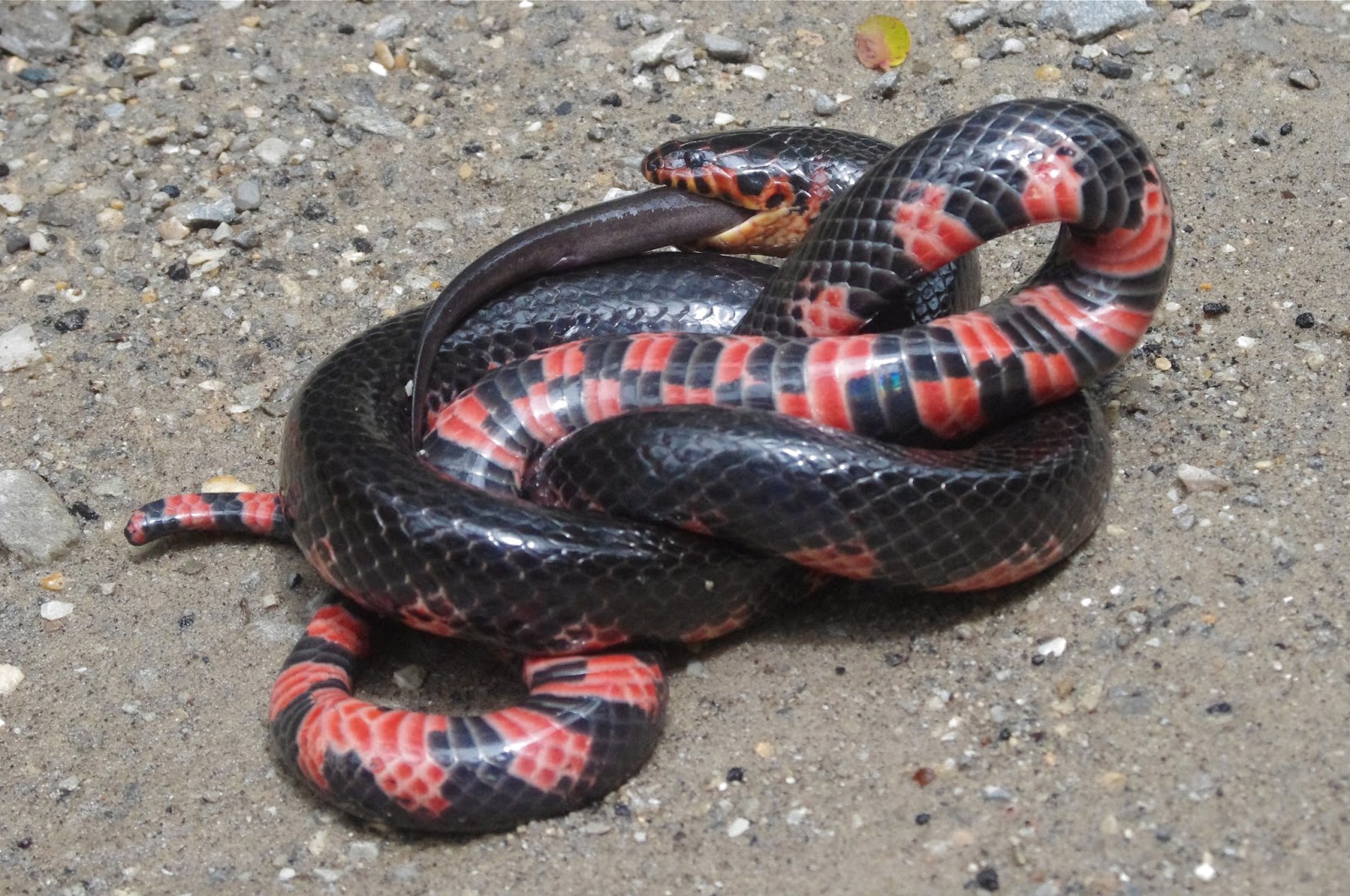
A small but secretive snake

Yesterday, while in the field, I finally caught an animal that previously I'd only seen once, and then only momentarily before it slipped away into murky waters at night. The snake is a Gulf Crayfish Snake (Regina rigida sinicola). As it's name would suggest, it specializes on eating crayfish; specifically ones that have recently shed their hard outer shell. However, it opportunistically eats other things as well, including other aquatic invertibrates, fish, sirens, frogs, and salamanders. This species is probably fairly common, but just difficult to find.


10.01.2009

Blue Thread (Burmannia biflora)


I spotted two of these diminutive plants (<10 cm tall) in a cypress dome swamp in the Florida panhandle today, and have no idea what they are, or even where to look to find out. They were herbaceous with tiny (<2 mm) leaves near the base that are pressed against the stem. The stem has one branch just below the visible flower that supported what was presumably another flower, or the bud of what will become a future flower. The flower structures were in threes, including three light violet rounded vertical "wings" and three yellowish ridges surrounding an opening at the apex, which presumably is where the flower is pollinated. The stem and leaves have some green color, but this plant may be some sort of parasite. The conspicuous leaves in the photos are not part of the mystery plant, but are mostly Eriocaulon compressum, and the nearest shrubs/trees were Nyssa sylvatica. If you have any tips, I'm all ears.

UPDATE: My friend Stella figured this plant out for me. It's called Blue Thread (Burmannia biflora), and is a myco-heterotrophic plant, which basically means it relies on underground fungus for energy production and would not survive without the fungus. The growth form with little to no leaves for photosynthesis is usually a giveaway that a plant is relying on another plant or fungus. Neat stuff.

8.16.2009

Seepage bog leps and flowers

I went scoping for skippers and flowers in a nice seepage bog with my friend Mary Ann.


Dusky Roadside-Skipper (Amblyscirtes alternata)


Arogos Skipper (Atrytone arogos)


Little Metalmarks (Calephelis virginiensis)


Pine Lily (Lilium catesbaei)


And lastly, a species that my friend Ben recently found in Indiana


Yellow Fringed Orchid (Platanthera ciliaris)

8.09.2009

Search for sirens, baby sea turtles, and other highlights

I recently went with my friends John and Brandon on a long and intense day-long search for 5-6 siren species in the Florida panhandle; most of which I hadn't seen. The weather was hot, and our efforts involved hauling what felt like tons of water and swampy muck and vegetation up onto the bank, followed by meticulous searching through all of it to look for anything long, slimy, and wriggly. To make a long story short, we traveled hundreds of miles to about half a dozen sites, drank gallons of fluids to replace all that we sweat, and physically wore ourselves out with no sirens to show for all our efforts...

until we were at our last site and about ready to give up. John said "one more scoop," and in the thick fluffy mud that was oozing out of his dipnet was a tiny movement that caught John's attention first. He yelled out and tried to grab it, only to have the mud shift and obscure the object of our intense interest. Brandon and I joined the frenzied search and after a couple more brief glimpses, I cupped a double handful of mud in my hands and dumped it into a net and sifted through it. To all of our delight there was our target in all it's tiny glory.


undescribed "Least" Siren (Siren cf intermedia (dwarf))


Sarah and I like to see baby sea turtles. We've gone to see them a few times since living here, and had a chance this weekend to see a species we hadn't seen yet.


Loggerhead (Caretta caretta)


My friend Dave caught this snake


Florida Pine Snake (Pituophis melanoleucus mugitus)


and this frog, which I had only seen in tadpole stage!


Dusky Gopher Frog (Lithobates sevosus)


While out scoping a seepage bog for skippers and flowers with my friend Mary Ann, I found something I had never found before in the middle of the day.


Pine Barrens Treefrog (Hyla andersonii)


I just liked this photo.


Ground Skink (Scincella lateralis)

8.08.2009

Catching up with some half year highlights

Here are some memorable (for me) little gems from my past few months.


My friend Kirk spotted one of these Okefenokee Zale Moth larvae (Zale perculta) while we were out looking for other things. It turned out to represent a ~100 mile extension to their previously known range. They feed exclusively on Climbing Fetterbush (Pieris phyllyreifolia), which is a pretty neat plant that you can learn more about HERE.


This Portuguese Man-O-War (Physalia physalis) is doomed to be churned in the surf and washed up on the beach. They float at the surface, have no ability to propel themselves, and are completely at the mercy of where the wind and surface currents direct them.


I was fortunate to be involved in the capture of this Black-banded Sunfish (Enneacanthus chaetodon) while seining for Greater Sirens (Siren lacertina). This beautiful little species hadn't been documented in Florida for many years, and my friend John recognized it for the special find it was.


While following a group of Red-cockaded Woodpeckers (Picoides borealis), I flushed up this young Red-shouldered Hawk (Buteo lineatus) which had just caught a Southern Black Racer (Coluber constrictor priapus). I took this low quality photo through a scope mounted on a gun stock, so the quality isn't very good, but I still like it.


This Oldfield Mouse (Peromyscus polionotus) was caught in a funnel trap set out to sample herps. I rarely see more than a glimpse of small mammals unless they're being trapped for, so this was a treat to see.


I happened upon this domesticated Muscovy Duck hen tending her recently hatched young back in a swampy area while looking for sirens. I'm including this photo for my mother, who has a special place in her heart for domesticated waterfowl. Also, the cute factor is admittedly pretty high.

7.28.2009

New blog!

With only three weeks to go until our son enters the world, we decided to create a more personal space to post updates, pictures, videos, etc. of the "family" side of our lives. Of course, it will largely feature the kiddo, but we'll try to keep it interesting with other things as well. Kelly will keep updating Onward, Westward with all of his great nature finds and photography, but if you're interested in following our personal side as well, check us out at htpp://us-plus.blogspot.com. We've also included a link under the "Links" heading on the right-hand sidebar to make it easy to go from one blog to the other.

If you decide to follow us there, we hope you'll enjoy it! If you're here just for the nature/biology fun, then keep coming back! Kelly will still maintain this site just like always -- and you won't have to scroll through baby pictures to find your target species. :)

6.25.2009

Polygala

I've recently been enjoying seeing the unique blossoms of plants in the genus Polygala.


Candyroot (Polygala nana)


Orange Milkwort (Polygala lutea)


Chapman's Milkwort (Polygala chapmanii)


Hooker's Milkwort (Polygala hookeri)


Procession Flower (Polygala incarnata)


Tall Pinebarren Milkwort (Polygala cymosa)


Linear to lanceolate basal leaves of P. cymosa


Low Pinebarren Milkwort (Polygala ramosa)


Elliptic to spatulate basal leaves of P. ramosa


Drumheads (Polygala cruciata)


Littleleaf Milkwort (Polygala brevifolia)
Similar to Drumheads, but with longer peduncle, typically shorter leaves, and blunter wings on each flower.


Showy Milkwort (Polygala violacea)


Racemed Milkwort (Polygala polygama)

Do scales and no legs always = snake?

No. There are a number of lizards with no legs (represented in North America by some members of the families Anguidae and Anniellidae, glass lizards and legless lizards, respectively), which are often mistaken for snakes. This confusion sometimes results in the stomping of these harmless lizards by highly sophisticated folks who think that "the only good snake is a dead snake" in their crusade to rid the land of the evil serpents, and other people simply miss an opportunity to recognize and appreciate a beautiful and unique lizard.

Here are a couple glass lizards, followed by some neat snakes I've recently found:


Subadult Eastern Glass Lizard (Ophisaurus ventralis)
In this photo, one can see the external ear opening just behind the jaw, which is one of the visible characteristics that distinguish a lizard from a snake.


Adult Eastern Glass Lizard


A new form of this species for me - "Yellow" Eastern Rat Snake (Scotophis alleghaniensis)


North Florida Black Swamp Snake (Seminatrix pygaea pygaea) almost ready to shed (notice the cloudy eyes)


Black Swamp Snake - with brightly-colored belly showing


A new species for me - Florida Green Water Snake (Nerodia floridana)

6.21.2009

Of things with slimy skin

Love is in the air for summer breeding amphibians.


Amplexed pair of Pine Woods Treefrogs (Hyla femoralis)


Amplexed pair of Barking Treefrogs (Hyla gratiosa)


Amplexed pair of Squirrel Treefrogs (Hyla squirella)


Amplexed pair of Eastern Narrowmouth Toads (Gastrophryne carolinensis)


Not to be confused with a love struck pair, this photo is for anyone who in hopes of seeing an Oak Toad (Anaxyrus quercicus) tried to make a juvenile Southern Toad (Anaxyrus terrestris) into an Oak Toad. Though potentially confusing, the Oak Toad (left) will always have a well defined mid-dorsal light stripe, whereas the juvenile Southern Toad (right) will have a low contrast, poorly defined mid-dorsal stripe, often with dark "warts" breaking the stripe. There are other helpful characteristics, but this alone will do the trick.


Calling male Oak Toad


Recent metamorph Eastern Spadefoot Toad (Scaphiopus holbrookii)


Adult Eastern Spadefoot Toad


A new one for me and North America's smallest frog (they're tiny!)
Little Grass Frog (Pseudacris ocularis)


A new subspecies for me
Florida Leopard Frog (Lithobates sphenocephalus sphenocephalus)


Also new for me - larval Striped Newt (Notophthalmus perstriatus)


Calling male Cope's Gray Treefrog (Hyla chrysoscelis)


My favorite - young Pine Barrens Treefrog (Hyla andersonii) staying on the outskirts of where the big males were calling


Adult male Pine Barrens Treefrog


video
This video is pretty funny, with the male's calls shaking his whole perch.